Conservation Areas and the Cotswolds Premium: Why Restrictions Drive Value
There is a common misconception among homeowners in conservation areas: that the planning restrictions imposed on their property are a disadvantage. That the inability to extend freely, to replace windows without consent, or to alter the roofline somehow diminishes the value of what they own.
The data tells a very different story. In the Cotswolds and Cheltenham prestige market, conservation area status is not a constraint on value — it is one of the most powerful drivers of it.
The Economics of Restriction
Property values are, at their most fundamental level, a function of supply and demand. And conservation areas manipulate both sides of that equation in favour of existing homeowners.
On the supply side, conservation designation severely limits new development. Local planning authorities — including Cheltenham Borough Council and Cotswold District Council — apply strict controls on new builds, extensions, demolitions, and external alterations within designated areas. The result is a fixed housing stock. In areas like Montpellier, The Park, Battledown, and the villages of the North Cotswolds, the number of homes available at any given time is constrained not by market forces but by policy.
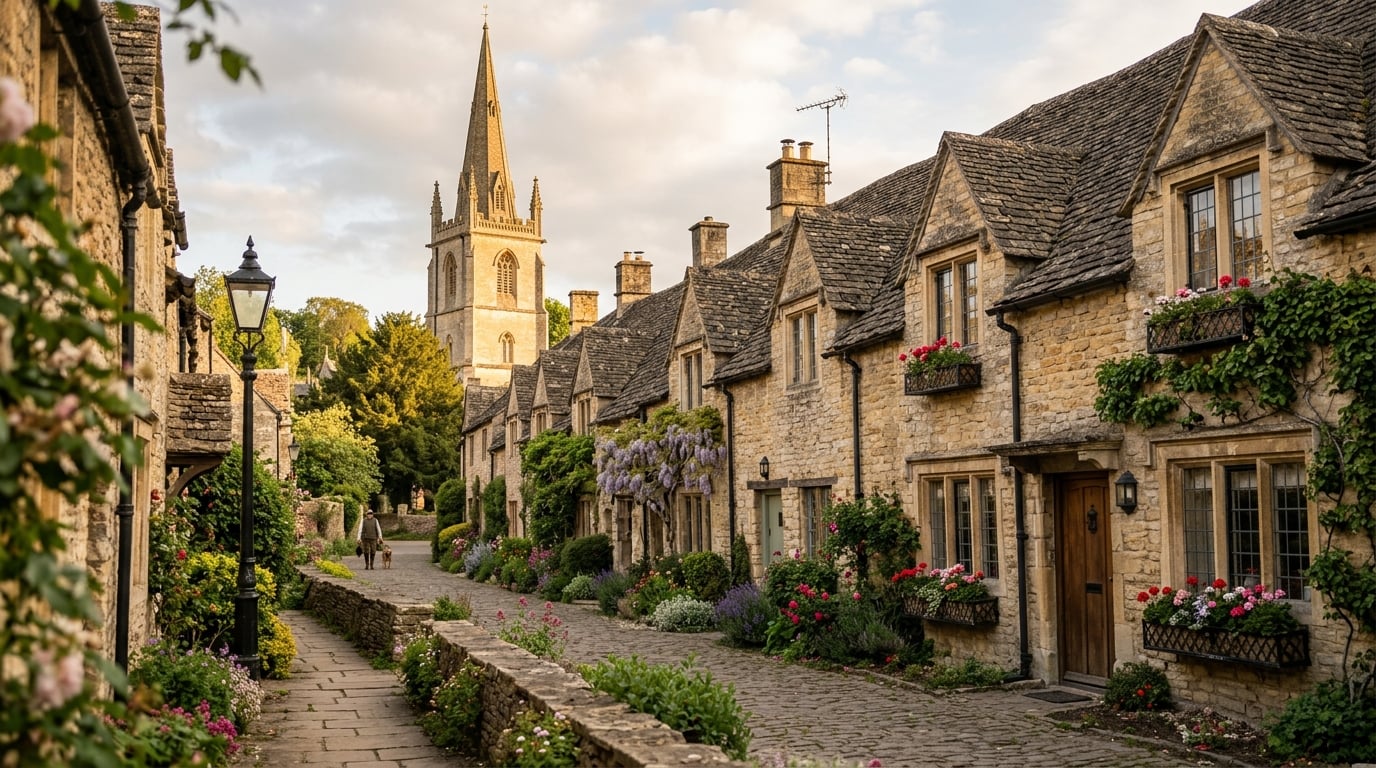
On the demand side, the very characteristics that conservation areas protect — architectural coherence, mature streetscapes, period detailing, green spaces — are precisely what prestige buyers are willing to pay a premium for. The restrictions do not deter buyers. They attract them.
What the Data Shows
Analysis of the Cotswolds and Cheltenham property market in mid-2026 reveals a striking pattern. Across the region, new listings are averaging just over £1 million, but properties in designated conservation areas — particularly in the £1.3 million to £1.35 million bracket — are commanding strong buyer interest and progressing to sale faster than the broader market.
In Cheltenham’s conservation zones, including The Park, Montpellier, and parts of Battledown, the premium over comparable properties outside designated areas is significant. Buyers in this bracket are typically purchasing not just a house but a streetscape, a neighbourhood character, and an assurance that these qualities will be preserved in perpetuity.
The Conservation Premium in Practice
Consider the practical implications for a homeowner in a conservation area. The restrictions that prevent you from building a large modern extension also prevent your neighbour from doing so. They prevent a developer from purchasing the plot next door and building three townhouses. They prevent the character of the street from being eroded by unsympathetic alterations.
In economic terms, conservation designation creates a form of collective property protection. Every homeowner benefits from the restrictions placed on every other homeowner. The result is a stable, predictable environment that preserves both character and value.
Planning Policy as a Value Shield
Current local planning policy in the Cotswolds reinforces this effect. Both Cheltenham Borough Council and Cotswold District Council have adopted policies that explicitly prioritise the preservation of heritage assets and conservation area character. New development proposals within these areas face heightened scrutiny, and external alterations — from replacement windows to boundary treatments — require conservation area consent.
For the prestige market, this policy environment creates three distinct advantages:
- Supply constraint. With limited scope for new builds and conversions, the housing stock in conservation areas remains largely fixed. This is particularly acute in sought-after villages such as Broadway, Stow-on-the-Wold, and Bourton-on-the-Water, where new development is almost entirely restricted to brownfield or infill sites that meet stringent design criteria.
- Character preservation. The architectural coherence of these areas is maintained over decades. A buyer purchasing a Cotswold stone property in a conservation village knows that the streetscape will look substantially the same in twenty years. This is a form of environmental assurance that is extremely valuable to prestige buyers.
- Buyer confidence. Conservation status signals quality. It tells prospective purchasers that the area has been formally recognised as having special architectural or historic interest. This designation carries weight — it is not a marketing claim but a legal status conferred by the local authority.
What This Means for Sellers
Homeowners in conservation areas often underestimate the value of their designation. Elliott frequently encounters clients who view conservation restrictions as a negative — something to apologise for in the marketing. The opposite approach is far more effective.
When marketing a conservation area property, the designation should be positioned as a feature, not a footnote. The restrictions are part of the value proposition. They are the reason the street looks the way it does, the reason the views are uninterrupted, and the reason the property is worth what it is.
Practical Considerations for Conservation Area Sales
Elliott advises clients selling within conservation areas to consider the following:
- Document any consented improvements. If you have undertaken works with conservation area consent — sympathetic extensions, restored sash windows, heritage-appropriate landscaping — these add demonstrable value. Ensure all consents and completion certificates are available for prospective buyers.
- Highlight the protection, not just the property. Buyers at this level are purchasing an environment. Photography and property films should capture the streetscape, the neighbouring properties, and the overall character of the area — not just the interior.
- Understand the buyer profile. Conservation area buyers tend to be more discerning, better informed, and less price-sensitive. They are often relocating from London or other urban centres specifically seeking the character and permanence that conservation areas provide. Marketing should reflect this sophistication.
- Price with confidence. The scarcity premium in conservation areas is real and measurable. Properties should be priced to reflect not just the bricks and mortar but the designation itself. Comparable evidence from outside the conservation area is, by definition, not truly comparable.
The Cross-Border Investment Factor
One additional dynamic is worth noting. With the Bank of England base rate at 3.75 per cent as of mid-2026, mortgage costs remain manageable for the prestige market’s core demographic. London equity — driven by buyers selling in the capital and relocating to the Cotswolds — continues to flow into the region, and conservation areas are disproportionately the beneficiaries.
These buyers are not seeking the cheapest option. They are seeking the best. And conservation area properties, with their protected character and constrained supply, consistently represent the top of the market.
In Summary
Conservation area designation in the Cotswolds and Cheltenham acts as a powerful value driver for prestige property. By restricting new development and preserving architectural character, planning policy creates genuine scarcity and environmental assurance that attracts premium buyers. Homeowners in conservation areas should view their planning restrictions not as limitations but as a form of collective value protection. Properties in the £1.3 million to £1.35 million bracket within these areas are showing particularly strong market activity in mid-2026, supported by London equity flows and stable interest rates. For a confidential discussion about what your conservation area property could achieve, get in touch with Elliott.

Elliott Wakefield
Member of the Chartered Institute of Marketing (MCIM) and Prestige Property Expert in Cheltenham and the Cotswolds. Licensed with The Prestige Property Experts.
About Elliott WakefieldReady to discuss your property?
Book a private market appraisal with no obligation.
Book a Market Appraisal