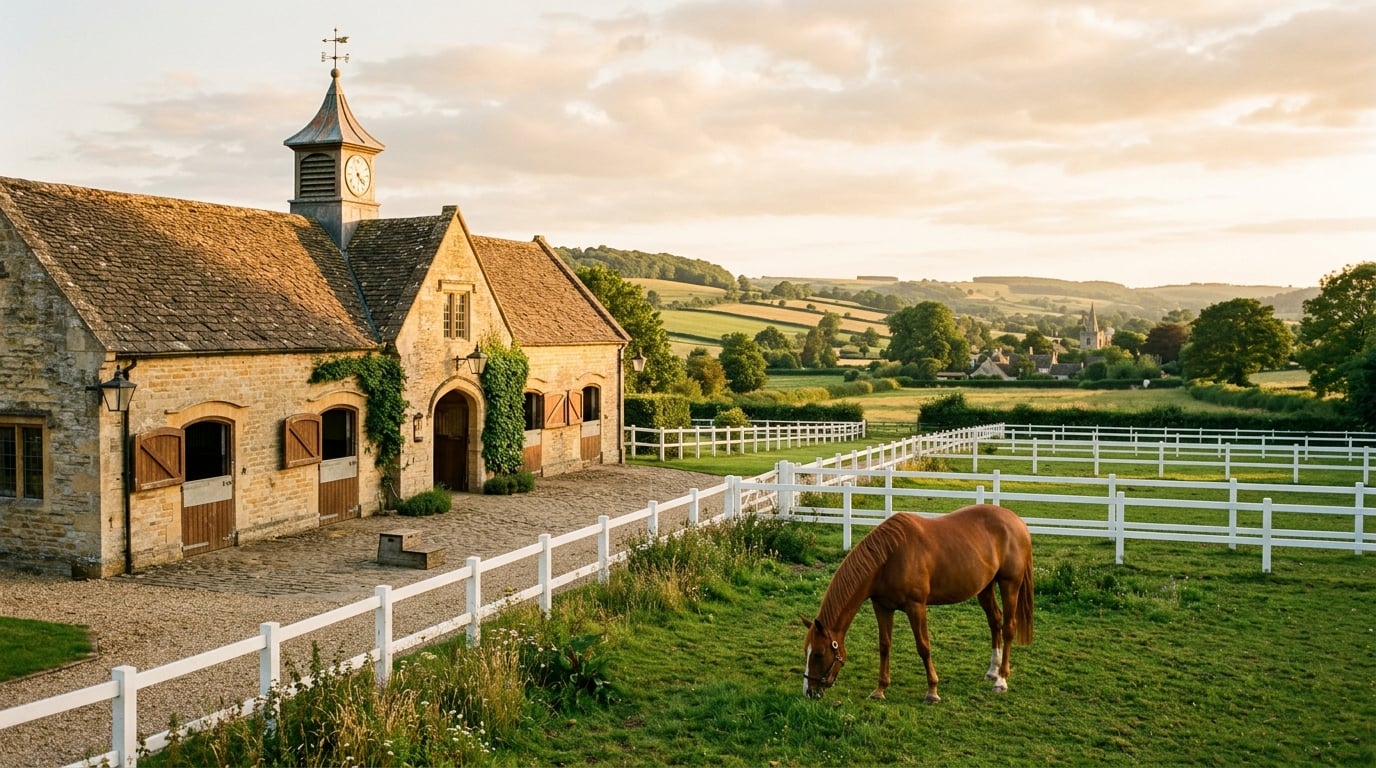
Equestrian Property in the Cotswolds: What Vendors Need to Know
The Cotswolds has long been one of England’s most active markets for equestrian property. From converted farmsteads with a single paddock to substantial estates with purpose-built stabling, indoor schools, and several acres of grazing, the region attracts a consistent pool of buyers who regard equestrian facilities not as a luxury addition but as a fundamental requirement. For vendors considering a sale, understanding how this specialist market operates — and how to present equestrian assets to best effect — can make a material difference to both the speed and the outcome of a transaction.
A Distinct Buyer Pool With Specific Priorities
Equestrian buyers are among the most purposeful in the prestige property market. Unlike buyers who might be persuaded by a beautiful kitchen or a well-planted garden, those seeking equestrian facilities arrive with a checklist that is largely non-negotiable: the number of stables, the quality of the grazing, the condition of the fencing, the availability of a school or manège, and — critically — the proximity of bridleways and hacking routes. Elliott Wakefield notes that this specificity is both a challenge and an opportunity for vendors: the audience is narrower, but those within it are highly motivated and rarely waste time on unsuitable properties.
The Cotswolds is particularly well-served in this regard. The region’s network of bridleways, its open countryside, and its established equestrian community make it one of the most sought-after locations in England for horse owners. Villages with direct access to open hacking — without the need to box horses to a suitable location — command a meaningful premium over otherwise comparable properties.
How Equestrian Facilities Are Valued
One of the most common misconceptions among vendors is that equestrian infrastructure adds value in direct proportion to what it cost to build. In practice, the relationship is more nuanced. A well-maintained, professionally constructed American barn with six loose boxes, a tack room, and a hay store will be recognised and valued by the right buyer. A collection of ageing timber stables in poor repair, however, may be viewed as a liability — requiring capital expenditure before the property is usable — rather than an asset.
The condition and specification of equestrian buildings matters considerably. Buyers at the prestige end of the market are accustomed to quality, and they will scrutinise stabling, surfaces, and drainage with the same critical eye they bring to the main house. Elliott advises vendors to address any obvious maintenance issues before marketing: replacing broken fencing, ensuring stable doors are functional, clearing and levelling the yard, and presenting the manège surface in good order. These are relatively modest investments that can significantly improve first impressions.
Land Quality and Acreage
The quality of the grazing land is as important as the buildings themselves. Buyers will assess whether the paddocks are well-managed, properly drained, and free from ragwort and other toxic plants. Overgrazed or poached ground, particularly after a wet winter, can create a poor impression even if the underlying land is sound. Where possible, vendors should consider resting paddocks ahead of marketing, topping and harrowing where appropriate, and ensuring that field boundaries — whether hedgerow, post-and-rail, or electric tape — are in good order.
Acreage is a significant factor, though the ideal amount varies by buyer. A serious competition rider may require ten acres or more; a leisure rider with two horses may be perfectly satisfied with three to four. Elliott Wakefield’s experience suggests that properties with between four and eight acres of well-managed grazing, combined with quality stabling, represent the broadest appeal within the Cotswolds equestrian market.
The Manège and Schooling Facilities
An all-weather manège or outdoor school is, for many equestrian buyers, the single most important facility after the stabling itself. The ability to school horses safely and consistently regardless of weather conditions is not a convenience — it is a practical necessity for anyone who rides regularly. A well-constructed manège with a quality surface, good drainage, and appropriate lighting will be viewed very favourably. Conversely, a neglected or poorly surfaced school may require significant remediation, and buyers will factor this into their offer.
Indoor schools, where present, represent a more substantial asset and will attract a narrower but highly committed buyer profile. Properties with indoor facilities tend to appeal to those with a more serious competitive or professional involvement with horses, and marketing should be calibrated accordingly.
Planning and Permitted Development
Equestrian properties often carry a degree of planning complexity that vendors should be aware of before going to market. Agricultural buildings erected under permitted development rights may have conditions attached to their use; stabling constructed without the appropriate consents can create complications during the conveyancing process. Elliott recommends that vendors obtain a clear picture of the planning history of all equestrian structures on the property before instructing solicitors, so that any issues can be addressed proactively rather than surfacing as a surprise during due diligence.
Similarly, any change of use — for example, converting agricultural land to equestrian use — should be documented and, where necessary, regularised. Buyers and their solicitors will ask these questions, and having clear answers ready demonstrates good faith and keeps the transaction moving smoothly.
Presenting the Property to Equestrian Buyers
Marketing an equestrian property requires a different emphasis from a conventional country house sale. Whilst the main residence remains central to the presentation, the equestrian facilities must be given equal prominence in photography, floorplans, and written descriptions. Aerial photography is particularly effective for equestrian properties, as it conveys the extent of the land, the layout of the paddocks, and the relationship between the house and the yard in a way that ground-level images cannot.
Elliott Wakefield works with vendors to ensure that equestrian facilities are presented at their best: yards swept and tidy, stables bedded down, paddocks looking their most presentable, and the manège surface freshly harrowed. These details matter to buyers who understand what they are looking at, and they signal that the property has been well cared for.
Timing and the Equestrian Market
The equestrian property market has its own seasonal rhythms, which do not always align precisely with the broader residential market. Spring and early summer tend to be the most active periods, as buyers wish to be settled before the main competition season and before the ground hardens in summer. Autumn can also be productive, as buyers look to be established before winter. Marketing during the depths of winter, when paddocks may be at their least presentable, is generally less advantageous — though the right property, priced correctly, will always find its buyer.
In Summary
Equestrian property in the Cotswolds occupies a distinctive and resilient corner of the prestige market. Vendors who take the time to present their facilities honestly and at their best — addressing maintenance, clarifying planning history, and working with an agent who understands the specialist buyer profile — are well placed to achieve a strong result. Elliott Wakefield brings both the local knowledge and the equestrian market experience to guide vendors through this process with confidence.

Elliott Wakefield
Member of the Chartered Institute of Marketing (MCIM) and Prestige Property Expert in Cheltenham and the Cotswolds. Licensed with The Prestige Property Experts.
About Elliott WakefieldReady to discuss your property?
Book a private market appraisal with no obligation.
Book a Market Appraisal